There are many theories revolving around comet 2012, the only problem is that there is no hard evidence to back up this story. It is spoken that a comet will hit planet earth in the year 2012, three years form now. This comet will cause the utter destruction of the human race and life, as we know it. No one knows where exactly this mythical comet will hit but they are sure that the impact site will judge if you live or die. Once the initial impact has happened almost two quarters of human's will be killed instantly. Huge tsunamis will envelop parts of the world.
The impact will be so massive it will send a huge dust cloud into the atmosphere; this will totally cover our plant and block the sun's life giving rays. The very air we breath, above ground will be poisonous to us. A new ice age will be ushered in, freezing all life. Many more will die except those who take shelter underground. Once the atmosphere returns to normal, only the strong willed person will survive. Humans will either prevail and start again from stones and twigs or we will be extinct and all other creatures who were once threatened by mankind will live a fair life and their numbers will recover rapidly.
Comet 2012? Some people think it will be a planet that will pass us in space. This planet has two names: Planet-X and Nibiru. It's the unknown world in our solar system, Nibru has a totally different orbit path to ours but every 3,630 years these two planets will meet. Just a harmless passing? No! if this theory is correct then be prepared for mayor earthquakes, tsunamis and violent whether as Nibru crosses through our orbit line. It would be an amazing sight to actually see another planet up close, it will be seen in the skies all around the world. But could this plant be inhabited by a new race of being, much more high tech then ourselves?
This is another theory that's being tossed around, not only is this planet inhabited by an advanced alien race called the giants, but these being are also our creators! The last time they came to our world it was during the pyramid times, they were seen as gods amongst us and were worshiped by humans. People build pyramids to honor time, hence the reason why nearly every continent has its own pyramid. The giants are a race to be feared, they care nothing for us and see us as we would see dirty rats. The only thing they want to do to us is to enslave us. There is much more to this story then what you read here.
What the two theories above have in common is that they were predicted by the Mayan calendar.
http://ufocomet.com
Article Source: http://EzineArticles.com/?expert=Max_Knight
Thursday, July 30, 2009

Comet Holmes 17P - Brightening By 1 Million Times to Naked Eye Visibility!
The Dramatic appearance of Comet Holmes 17P
Comet 17P (Holmes) has brightened by over 6 orders of magnitude since October 24th, with another significant (10 fold) increase of brightness at 1500 UST on the 29th. Holmes was discovered and catalogued in 1892 by Edwin Holmes, who observed its eruption in that year. It's now naked eye visible in the constellation Perseus, as a brightly visible extra yellow star. At magnitude 2.8, it's brighter than most of the stars in Cassiopeia and the Big Dipper. Because it's shifting by nearly a 7th of a degree per evening, its very clearly a non-stellar object. 17P Holmes has an eccentric orbit that runs from roughly 2.054 AU at aphelion (closest point to the sun) and 5.02 AU at perihelion. One AU is an Astronomical Unit, and is an Earth-orbital radius. It's approximately 500 light seconds to the AU, or 150,000,000 km.
17P Holmes reached its aphelion last May, and was roughly 2.77 AU from Earth at the time, with the Earth trailing in its orbit relative to Holmes. To picture this, picture a board with a circle drawn on it that's 20 millimeters in diameter, that's Earth's orbit. In the center of that circle, put in a yellow push-pin for the sun. Now put an ellipse around that runs from 20.5 millimeters out to 50.2 millimeters. Earth travels counter clockwise around the sun in this view, and if you imagine that the circle has 12 clock facings, when Holmes was at its closest approach to the Sun, Earth was nearly at 6'oclock, while Holmes was at roughly 12 o'clock. Now, Holmes is sweeping out from the sun (and is at 2.77 AU, or 27.7 millimeters in the diagram we described above).
Both Holmes and Earth are at almost exactly 2 o'clock relative to the sun, with Holmes about 17 millimeters away from the Earth. It's this quirk of orbital positioning - the fact that the Earth is nearly on a direct line between the Sun and Holmes, that the tail is almost impossible to see. Comet tails are caused by the sun's light boiling off volatiles (mostly carbon dioxide, methane and other compounds) and taking dust with them that reflects the sunlight.
We are still uncertain what's causing Holmes to erupt the way it is - scientists at the LPL Observatory in Tucson, Arizona, are doing an extensive series of spectrographic tests on the coma of Holmes, which has nearly tripled in diameter with this change in brightness - or taken up nearly 27x the volume. Their aim is to see if they can determine what's caused the eruption from the outgassing that they're seeing. The current candidate is an ethane explosion deep in the comet's nucleus, though their Monday night (29 October) observation data hasn't been released yet.
You may be wondering why NASA hasn't pointed the Hubble Space Telescope at Holmes, or why there aren't more "big telescope" pictures of Holmes. In large part, this is because observation time on major observatory scopes is booked MONTHS in advance, and for the Hubble, it's booked over a year in advance. Trying to bring Holmes in for a beauty shot with one of these gigantic instruments, particularly as it's receding from Earth, would result in disrupting schedules for years (and the Hubble may not have many more years left, making the Goddard Space Flight center very Wary about opening that can of scheduling worms.)
To discover more about the night sky and how you can master it's hidden secrets for yourself, download a f.r.e.e copy of my Audio "Night sky secrets revealed" at http://www.nightskysecrets.com
Ian Maclean - Astronomy Author and PresenterHomepage: http://www.nightskysecrets.comBlogpage: http://www.nightskysecrets.com/blog
Article Source: http://EzineArticles.com/?expert=Ian_Maclean
Comet 17P (Holmes) has brightened by over 6 orders of magnitude since October 24th, with another significant (10 fold) increase of brightness at 1500 UST on the 29th. Holmes was discovered and catalogued in 1892 by Edwin Holmes, who observed its eruption in that year. It's now naked eye visible in the constellation Perseus, as a brightly visible extra yellow star. At magnitude 2.8, it's brighter than most of the stars in Cassiopeia and the Big Dipper. Because it's shifting by nearly a 7th of a degree per evening, its very clearly a non-stellar object. 17P Holmes has an eccentric orbit that runs from roughly 2.054 AU at aphelion (closest point to the sun) and 5.02 AU at perihelion. One AU is an Astronomical Unit, and is an Earth-orbital radius. It's approximately 500 light seconds to the AU, or 150,000,000 km.
17P Holmes reached its aphelion last May, and was roughly 2.77 AU from Earth at the time, with the Earth trailing in its orbit relative to Holmes. To picture this, picture a board with a circle drawn on it that's 20 millimeters in diameter, that's Earth's orbit. In the center of that circle, put in a yellow push-pin for the sun. Now put an ellipse around that runs from 20.5 millimeters out to 50.2 millimeters. Earth travels counter clockwise around the sun in this view, and if you imagine that the circle has 12 clock facings, when Holmes was at its closest approach to the Sun, Earth was nearly at 6'oclock, while Holmes was at roughly 12 o'clock. Now, Holmes is sweeping out from the sun (and is at 2.77 AU, or 27.7 millimeters in the diagram we described above).
Both Holmes and Earth are at almost exactly 2 o'clock relative to the sun, with Holmes about 17 millimeters away from the Earth. It's this quirk of orbital positioning - the fact that the Earth is nearly on a direct line between the Sun and Holmes, that the tail is almost impossible to see. Comet tails are caused by the sun's light boiling off volatiles (mostly carbon dioxide, methane and other compounds) and taking dust with them that reflects the sunlight.
We are still uncertain what's causing Holmes to erupt the way it is - scientists at the LPL Observatory in Tucson, Arizona, are doing an extensive series of spectrographic tests on the coma of Holmes, which has nearly tripled in diameter with this change in brightness - or taken up nearly 27x the volume. Their aim is to see if they can determine what's caused the eruption from the outgassing that they're seeing. The current candidate is an ethane explosion deep in the comet's nucleus, though their Monday night (29 October) observation data hasn't been released yet.
You may be wondering why NASA hasn't pointed the Hubble Space Telescope at Holmes, or why there aren't more "big telescope" pictures of Holmes. In large part, this is because observation time on major observatory scopes is booked MONTHS in advance, and for the Hubble, it's booked over a year in advance. Trying to bring Holmes in for a beauty shot with one of these gigantic instruments, particularly as it's receding from Earth, would result in disrupting schedules for years (and the Hubble may not have many more years left, making the Goddard Space Flight center very Wary about opening that can of scheduling worms.)
To discover more about the night sky and how you can master it's hidden secrets for yourself, download a f.r.e.e copy of my Audio "Night sky secrets revealed" at http://www.nightskysecrets.com
Ian Maclean - Astronomy Author and PresenterHomepage: http://www.nightskysecrets.comBlogpage: http://www.nightskysecrets.com/blog
Article Source: http://EzineArticles.com/?expert=Ian_Maclean
Sunday, July 26, 2009
What is a Comet?
Comets are small Solar System bodies that are caught in the Sun's orbit. When a comet is close to the sun they exhibit a visible coma, otherwise known as a tail, which effects the solar radiation from the comet's nucleus. Comet nuclei are made up of loose collections of ice, dust, and small rocky particles.
The orbit of a comet ranges from a few years to hundreds of thousands of years. Some comets flow through the Solar System once before being thrown out into interstellar space. Short period comets are thought to be created in the Kuiper belt (which is associated with the scattered disc) while long period comets originate at a great distance from the sun, perhaps in the Oort cloud. These comets are thought to be made of debris left over from the condensation of the solar nebula. Comets are thrown into the inner solar system by the gravitational push of other stars.
The trail of debris following comets is what shows as a comet's path crosses the earth's path. A meteor shower occurs every year between August ninth and thirteenth when the Earth passes through the orbit of the comet Swift-Tuttle. Halley's Comet causes the Orionid shower in October.
Comets are easily distinguished from asteroids by the presence of the comet tail, also known as a coma. However, very old comets may have lost all of their volatile materials that cause a coma and may eventually resemble asteroids. Asteroids are suspected to form in the inner Solar System, rather than the outer Solar system.
As of June 2008 there were 3475 known comets reported. Several hundred of these comets appear to be short period comets. However, the number of comets appear to be steadily increasing. This number does represent a small amount of the total potential comet population.
Alex Sutton has worked in the telescopes profession for nearly 11 years. For more information please visit telescopes
Article Source: http://EzineArticles.com/?expert=Alexander_Sutton
The orbit of a comet ranges from a few years to hundreds of thousands of years. Some comets flow through the Solar System once before being thrown out into interstellar space. Short period comets are thought to be created in the Kuiper belt (which is associated with the scattered disc) while long period comets originate at a great distance from the sun, perhaps in the Oort cloud. These comets are thought to be made of debris left over from the condensation of the solar nebula. Comets are thrown into the inner solar system by the gravitational push of other stars.
The trail of debris following comets is what shows as a comet's path crosses the earth's path. A meteor shower occurs every year between August ninth and thirteenth when the Earth passes through the orbit of the comet Swift-Tuttle. Halley's Comet causes the Orionid shower in October.
Comets are easily distinguished from asteroids by the presence of the comet tail, also known as a coma. However, very old comets may have lost all of their volatile materials that cause a coma and may eventually resemble asteroids. Asteroids are suspected to form in the inner Solar System, rather than the outer Solar system.
As of June 2008 there were 3475 known comets reported. Several hundred of these comets appear to be short period comets. However, the number of comets appear to be steadily increasing. This number does represent a small amount of the total potential comet population.
Alex Sutton has worked in the telescopes profession for nearly 11 years. For more information please visit telescopes
Article Source: http://EzineArticles.com/?expert=Alexander_Sutton
Monday, July 20, 2009
Mysterious comets and igniting planets? No, they're mostly just ghosts...
Regular viewers of SOHO and STEREO data are well familiar with the variety of strange artifacts we see in the satellites images sometimes. We see various strange blobs, reflections and streaks, and I frequently get emails about them (which is something I strongly encourage: you learn by asking questions, so ask away!). Of course, all of these things we see in the data are completely explainable when armed with the appropriate knowledge of CCD detectors (like in digital cameras) and instrument optics (telescopes, lenses, etc). So after over 13 years of SOHO/LASCO images, we have seen and explained every weird artefact that has appeared in the data, and occasionally responded to a few popular myths. More recently (October 2006), we launched the STEREO/SECCHI mission and began send back data from that too. As expected, the STEREO/SECCHI 'COR2' telescopes see exactly the same blobs and streaks (dust, cosmic rays, etc) that we see in LASCO. So no explanation needed there. But the Heliospheric Imagers (HI) are a new kind of telescope and with that comes a new set of strange image effects. So what I'm going to do here is address the two most commonly questioned artifacts that we see in the HI images and explain what they are and why we see them. Read on for the full explanation...
Did that planet just explode?
A few hours before this image was taken, Venus was typical looking planet in the HI-1 field of view: it was bright, as expected, and had the vertical saturation spikes like those you see in Mercury in the image (the other bright spot). But then just as it reached the edge of the images, it got huge! And prior to that, it seemed to throw a mass ejection (a "VME" perhaps??) of its own out at the Sun. What happened?Check out the movie here (~8Mb .mov) or here (~5Mb mpeg4). Again, the other bright dot is Mercury.On a certain popular Internet video sharing website there are a couple of videos of this particular time sequence and a number of... interesting... interpretations of what's happening, the primary conclusion being that Jupiter had just been ignited by a passing CME! It's an intriguing prospect but a little wide of the mark for a couple of reasons: 1. It's Venus, not Jupiter. This image shows the inner solar-system planets on January 31, 2009 (the particular date in question), and Venus is clearly in the field-of-view of the STEREO-B spacecraft, just to the 'right' of Mercury as seen from the instruments.2. Coronal Mass Ejections (CMEs) can not and do not "ignite" things. They are not made of fire or any other flammable material! They are a diffuse cloud of plasma with an embedded magnetic field, and the only reason we can see them is because of sunlight scattering off of electrons in the CME. 3. Planets do not ignite under ordinary circumstances (and these were very ordinary circumstances!). Eventually the Sun will expand and engulf the inner planets of the solar system. But that's a few billion years away yet, and an entirely different situation. So what is this? Well, this is an artefact of optics and reflections. The 'Venus Mass Ejection' is what we call a ghost, and is the result of bright light reflecting off part of the instrument and entering the optical system of the telescope. (Another example is marked in this neat 1.8Mb .avi movie sent to me by SOHO/STEREO comet hunter Alan Watson.) The 'exploding/igniting' is slightly different, and is caused by light diffracting at the very edge of the instrument optical system. I'll give a little more detail about these in a moment, but first will address the other strange feature that gets me a few extra messages in my inbox.
Where did that bright comet come from?
At first glance, you would say that the image opposite shows a comet. It certainly looks like one. Check out the movies here (~5Mb .mov) or here (~3Mb mpeg4). Once again, the other bright dot is Mercury.There's a crucial clue that proves it isn't a comet: in this image, the Sun is on the left. A comet's tail always points away from the Sun, because it is formed by the solar wind flowing out from the Sun, so clearly this can not be a comet. So what's happening here? Well, it's essentially the same thing as described above, namely that a very bright object is at a certain point outside of the field of view of the camera, and is shining brightly on just the correct spot on the instrument such that its light is reflected in the detector and lens barrel cavities, creating the artefact you see. In this particular example, this artefact was seen immediately after Venus left the images, so it's pretty obvious that the two are related. But the same thing can happen if a bright object is about to enter the images, giving the appearance of an abruptly appearing and disappearing bright "comet".
Slightly more technical explanationSo why did Venus appear to explode? What of the apparent ejection from Venus? As I mentioned, they are a result what we call "stray light" and "ghosting", and are basically due to a very bright object just creeping out of direct view of our cameras and the light from that object reflecting off of various parts of the instrument. To explain it better, it's helpful to look at the design of the HI instrument. The Heliospheric Imager instrument has a series of lenses designed to give us the optimum performance and sensitivity while minimizing the effect of extremely bright objects in the field of view. Remember: we're trying to detect the incredibly faint signal of solar outflow and corona (atmosphere), so the telescope has to be really, really sensitive to faint signals. In addition, this camera uses a very long exposure times -- 40-minutes per image, in fact! Planets like Venus are incredibly bright, especially when you're up in space with no atmosphere to diffuse their light, and so when they shine into our camera, there is only so much we can do to stop 'bad' reflections. As you can probably image, before launching a mission like STEREO it is vital that we design our instruments so that the stray light does not blind us. To help do this, we do 'ray tracing' simulations on computer models of our telescopes to simulate how beams of light will react as they enter the instrument. If you click on the image to the right, it will show an expanded diagram that I put together (which is why it's not very good...) that illustrates how a bright object is causing the 'ghosts' I have described above. At the top of the image is a 'ray tracing simulation' that shows bright light from some object being focused onto a point away from the CCD detector. This bright light then reflects back into the lens system and ultimately reaches the CCD as a very faint signal. The example given in the image is more specifically for the ring that emanated from Venus (the "VME"!). In the case of the 'mysterious comet', the explanation is partly as above but is more related to diffraction, which in this instance is the 'bending' of light waves around the edge of the telescope and instrument. Refraction is very common in optical systems but the effect is amplified in the HI instrument because of the very sensitive optics and the fact that our exposure times are so long. Any faint refraction (or reflection) that reaches the camera is going to accumulate in brightness for the entire duration of the exposure (~40-mins). So it's is actually an incredible feat of design and engineering that our telescopes have so very few artifacts in them! So as cool as it may seem for comets to suddenly appear, and planets to suddenly ignite, the true explanation is a little less exciting but hopefully, at least, a little interesting... (Many thanks to Jean-Philippe Halain (Centre Spacial de Liege, Belgium) for the ray-tracing diagram and technical assistance with this article!)
Did that planet just explode?
A few hours before this image was taken, Venus was typical looking planet in the HI-1 field of view: it was bright, as expected, and had the vertical saturation spikes like those you see in Mercury in the image (the other bright spot). But then just as it reached the edge of the images, it got huge! And prior to that, it seemed to throw a mass ejection (a "VME" perhaps??) of its own out at the Sun. What happened?Check out the movie here (~8Mb .mov) or here (~5Mb mpeg4). Again, the other bright dot is Mercury.On a certain popular Internet video sharing website there are a couple of videos of this particular time sequence and a number of... interesting... interpretations of what's happening, the primary conclusion being that Jupiter had just been ignited by a passing CME! It's an intriguing prospect but a little wide of the mark for a couple of reasons: 1. It's Venus, not Jupiter. This image shows the inner solar-system planets on January 31, 2009 (the particular date in question), and Venus is clearly in the field-of-view of the STEREO-B spacecraft, just to the 'right' of Mercury as seen from the instruments.2. Coronal Mass Ejections (CMEs) can not and do not "ignite" things. They are not made of fire or any other flammable material! They are a diffuse cloud of plasma with an embedded magnetic field, and the only reason we can see them is because of sunlight scattering off of electrons in the CME. 3. Planets do not ignite under ordinary circumstances (and these were very ordinary circumstances!). Eventually the Sun will expand and engulf the inner planets of the solar system. But that's a few billion years away yet, and an entirely different situation. So what is this? Well, this is an artefact of optics and reflections. The 'Venus Mass Ejection' is what we call a ghost, and is the result of bright light reflecting off part of the instrument and entering the optical system of the telescope. (Another example is marked in this neat 1.8Mb .avi movie sent to me by SOHO/STEREO comet hunter Alan Watson.) The 'exploding/igniting' is slightly different, and is caused by light diffracting at the very edge of the instrument optical system. I'll give a little more detail about these in a moment, but first will address the other strange feature that gets me a few extra messages in my inbox.
Where did that bright comet come from?
At first glance, you would say that the image opposite shows a comet. It certainly looks like one. Check out the movies here (~5Mb .mov) or here (~3Mb mpeg4). Once again, the other bright dot is Mercury.There's a crucial clue that proves it isn't a comet: in this image, the Sun is on the left. A comet's tail always points away from the Sun, because it is formed by the solar wind flowing out from the Sun, so clearly this can not be a comet. So what's happening here? Well, it's essentially the same thing as described above, namely that a very bright object is at a certain point outside of the field of view of the camera, and is shining brightly on just the correct spot on the instrument such that its light is reflected in the detector and lens barrel cavities, creating the artefact you see. In this particular example, this artefact was seen immediately after Venus left the images, so it's pretty obvious that the two are related. But the same thing can happen if a bright object is about to enter the images, giving the appearance of an abruptly appearing and disappearing bright "comet".
Slightly more technical explanationSo why did Venus appear to explode? What of the apparent ejection from Venus? As I mentioned, they are a result what we call "stray light" and "ghosting", and are basically due to a very bright object just creeping out of direct view of our cameras and the light from that object reflecting off of various parts of the instrument. To explain it better, it's helpful to look at the design of the HI instrument. The Heliospheric Imager instrument has a series of lenses designed to give us the optimum performance and sensitivity while minimizing the effect of extremely bright objects in the field of view. Remember: we're trying to detect the incredibly faint signal of solar outflow and corona (atmosphere), so the telescope has to be really, really sensitive to faint signals. In addition, this camera uses a very long exposure times -- 40-minutes per image, in fact! Planets like Venus are incredibly bright, especially when you're up in space with no atmosphere to diffuse their light, and so when they shine into our camera, there is only so much we can do to stop 'bad' reflections. As you can probably image, before launching a mission like STEREO it is vital that we design our instruments so that the stray light does not blind us. To help do this, we do 'ray tracing' simulations on computer models of our telescopes to simulate how beams of light will react as they enter the instrument. If you click on the image to the right, it will show an expanded diagram that I put together (which is why it's not very good...) that illustrates how a bright object is causing the 'ghosts' I have described above. At the top of the image is a 'ray tracing simulation' that shows bright light from some object being focused onto a point away from the CCD detector. This bright light then reflects back into the lens system and ultimately reaches the CCD as a very faint signal. The example given in the image is more specifically for the ring that emanated from Venus (the "VME"!). In the case of the 'mysterious comet', the explanation is partly as above but is more related to diffraction, which in this instance is the 'bending' of light waves around the edge of the telescope and instrument. Refraction is very common in optical systems but the effect is amplified in the HI instrument because of the very sensitive optics and the fact that our exposure times are so long. Any faint refraction (or reflection) that reaches the camera is going to accumulate in brightness for the entire duration of the exposure (~40-mins). So it's is actually an incredible feat of design and engineering that our telescopes have so very few artifacts in them! So as cool as it may seem for comets to suddenly appear, and planets to suddenly ignite, the true explanation is a little less exciting but hopefully, at least, a little interesting... (Many thanks to Jean-Philippe Halain (Centre Spacial de Liege, Belgium) for the ray-tracing diagram and technical assistance with this article!)
Observing Comets
British Astronomical AssociationComet Section - further informationElsewhere on these pages: Highlights / Newly discovered comets / Periodic comets / Contributing observations / Comet Ephemerides / Upcoming Comets / Observing Comets / Current meteor showers / Links / Meetings / IWCA / Publications / Comments and Contacts / Old 2009 News / SPA News / Comet discovery procedure / Weather information / The Comet's Tale
Observing comets
For the beginner: Details of a comet and good and bad observations.
Some hints and tips on how to improve your observations.
Christopher Taylor contributed an article to the section newsletter which describes how to carry out simple spectroscopic studies of comets.
The Edgar Wilson Award has been instituted for amateur comet discoveries.
The 1999 Edgar Wilson Award was divided among the following six individuals or groups: Peter Williams, Heathcote, N.S.W., Australia, for C/1998 P1; Roy A. Tucker, Tucson, AZ, U.S.A., for P/1998 QP_54; Michael Jager, Weissenkirchen i.d. Wachau, Austria, for P/1998 U3; Justin Tilbrook, Clare, S.A., Australia, for C/1999 A1; Korado Korlevic and Mario Juric, Visnjan, Croatia, for P/1999 DN_3; and Steven Lee, Coonabarabran, N.S.W., Australia, for C/1999 H1. [IAUC 7223, 1999 July 14]
The 2000 Award was divided between the following three individuals or groups: Daniel W. Lynn, Kinglake West, Victoria, Australia, for C/1999 N2; Korado Korlevic, Visnjan, Croatia, for P/1999 WJ_7; and Gary Hug and Graham E. Bell, Eskridge, KS, U.S.A., for P/1999 X1. [IAUC 7445, 2000 June 29]
The 2001 Edgar Wilson Award for the discovery of comets was divided among the following two amateur astronomers for C/2000 W1: Albert Francis Arthur Lofley Jones, Stoke, Nelson, New Zealand; and Syogo Utsunomiya, Minami-Oguni machi, Aso-gun, Kumamoto-ken, Japan. [IAUC 7652, 2001 June 29]
The 2002 Edgar Wilson Award for the discovery of comets was divided among the following seven individuals: Vance Avery Petriew, Regina, SK, Canada, for P/2001 Q2; Kaoru Ikeya, Mori, Shuchi, Shizuoka, Japan, and Daqing Zhang, Kaifeng, Henan province, China, for C/2002 C1; Douglas Snyder, Palominas, AZ, U.S.A., and Shigeki Murakami, Matsunoyama, Niigata, Japan, for C/2002 E2; Syogo Utsunomiya, Minami-Oguni, Aso, Kumamoto, Japan, for C/2002 F1; William Kwong Yu Yeung, Benson, AZ, U.S.A., for P/2002 BV. [IAUC 7926, 2002 June 24]
The 2003 Edgar Wilson Award for the discovery of comets was divided among the following five individuals: Sebastian Florian Hoenig, Dossenheim, Germany, for C/2002 O4; Tetuo Kudo, Kikuchi, Kumamoto, Japan, and Shigehisa Fujikawa, Mitoyo, Kagawa, Japan, for C/2002 X5; Charles Wilson Juels, Fountain Hills, AZ, U.S.A., and Paulo Renato Centeno Holvorcem, Campinas, Brazil, for C/2002 Y1. [IAUC 8162, 2003 July 2]
The 2004 Edgar Wilson Award for the discovery of comets was divided among the following two individuals: Vello Tabur, Wanniassa, A.C.T., for C/2003 T3; and William A. Bradfield, Yankalilla, S. Australia, for C/2004 F4. [IAUC 8372, 2004 July 12]
The 2005 Edgar Wilson Award for the discovery of comets was divided among the following two individuals: Roy A. Tucker, Tucson, AZ, U.S.A., for C/2004 Q1; and Donald Edward Machholz, Jr., Colfax, CA, U.S.A., for C/2004 Q2. [IAUC 8554, 2005 June 30]
The 2006 Edgar Wilson Award for the discovery of comets was divided among the following three individuals: Charles Wilson Juels (Fountain Hills, AZ, U.S.A.) and Paulo Renato Centeno Holvorcem (Campinas, Brazil) for C/2005 N1; and John Broughton (Reedy Creek, Qld., Australia) for P/2005 T5. [IAUC 8730, 2006 July 17]
The 2007 Edgar Wilson Award for the discovery of comets was divided among the following three individuals: John Broughton (Reedy Creek, Qld., Australia) for C/2006 OF_2; David H. Levy (Tucson, AZ, U.S.A.) for P/2006 T1; and Terry Lovejoy (Thornlands, Qld., Australia) for C/2007 E2 and C/2007 K5. [IAUC 8854, 2007 July 11]
The 2008 Edgar Wilson Award for the discovery of comets was divided among the following two individuals for the discovery of C/2008 C1: Tao Chen (Suzhou City, Jiangsu province, China) and Xing Gao (Urumqi, Xinjiang province, China). [IAUC 8962, 2008 August 1]
Maik Meyer has a catalogue of comet discoveries. Don Machholz "A decade of comets" gives an account of discoveries between 1975 and 1984, and Don also has spreadsheets giving further information on amateur discoveries to date. He also provide an account of his searching in a message posted on 2008 May 6.
Current meteor showers
Meteors are the debris of comets and a meteor shower occurs if a comet's orbit intersects the earth's orbit. It is always worth watching for sporadic meteors as you never know when an outburst from some minor shower may take place. Several showers have produced enhanced returns over the last few years. [Updated 2007 September 11]
Cédric Bemer notes that the Earth passes 0.005 AU inside the orbit of comet 2006 VZ13 on 2008 May 27.1 (solar longitude 66 degrees) and that there may be a possibility of a meteor shower. The radiant is around RA 330 +16. Interestingly Peter Jenniskens lists the gamma Delphinid shower, which has a broadly similar orbit and is active from June 1 - 20 from a radiant around RA 320 +12. Jenniskens gives a possible outburst on 2013 June 11.
The 2007 Orionids gave an unexpectedly strong return, with ZHR of over 50.
More information on meteor showers can be found from
Gary Kronk
Gary Kronk's European mirror site
Phil Bagnall
International Meteor Organisation
Spaceweather
BAA Meteor Section
Other sources of information
This section gives a list of helpful urls [Updated 2002 May 14].
Meetings
This section gives details of meetings that have been held, and advance notice of forthcoming meetings.
An IWCA was held in Paris in 2004 from June 4 to 6, in association with the transit of Venus. IWCA III home page
A pro-am meeting on Comets and Meteorites was held on 2003 May 10. This included the inaugural George Alcock Memorial Lecture, which was given by Brian Marsden. The meeting was held in Milton Keynes at the Open University. Other speakers included Neil Bone, Alan Fitzsimmons, David Hughes, Monica Grady, Andrew Elliot, Iwan Williams, Nick James, Graeme Waddington and myself. Programme.Meeting report.
The "Meeting on Asteroids and Comets in Europe", MACE 2003, was held from May 1st to 4th at the Mallorca Observatory, Costitx, Mallorca, Spain.
There was an RAS discussion meeting on Cometary Science at the Launch of Rosetta on 2002 December 13 at the Geological Society Lecture Theatre, Burlington House. For more details see the RAS Meetings Calendar. An account appeared in the Aril 2003 issue of The Comet's Tale.
The Asteroids Comets Meteors (ACM2002) conference was held in Berlin from July 29 to August 2, 2002. Information on the conference is available at the meeting web site. Notes from the meeting appear in the October 2002 issue of The Comet's Tale.
There was a Section meeting associated with the BAA Ordinary meeting on Saturday 2002 February 23, notes from the meeting are included in the April 2002 issue of The Comet's Tale.
A recent professional meeting was the "5 Years After Hale Bopp" conference held in Tenerife January 21-25, 2002. Information on this conference is available at the meeting web site.
The second International Workshop on Cometary Astronomy was held in Cambridge over the weekend following the total eclipse on 1999 August 11. Details of IWCA2.
Publications The new revised and expanded comet section 'Observing Guide to Comets' is available from the BAA Office at a cost of GBP 3.50, or at selected BAA events for 3.00. Overseas and UK observers can now purchase items from the BAA Sales desk using credit cards. The Guide describes all the details you need to record to make a scientifically useful observation and also helps beginner observers to locate and view comets.
The Section Newsletter 'The Comet's Tale' is published once a year. BAA Members of the Section who contribute observations or other material receive a printed copy free of charge. Other BAA Members may subscribe to it at the rate of 5.00 pounds for three years or download it from the web. Rates for overseas members and non BAA members are negotiable. Subscriptions may be paid by credit card. The latest issue is 2007 January. Back issues for April 1999, October 1999, April 2000, October 2000, April 2001, October 2001, April 2002, October 2002, April 2003, October 2003, April 2004, October 2004, April 2005, October 2005, April 2006, January 2007, December 2007 and December 2008 are available in pdf format.
The ICQ has published a very comprehensive guide to observing comets, which covers historical observations and theory to degree level. Further details are available from the ICQ pages. This is now out of print, but may be published commercially in the near future. Some recent ICQ articles are published on line.
Pamphlet on the George Alcock memorial plaque Martin Mobberley has created a web page on George Alcock.
There is an interesting perspective on the Kuiper Belt and Comets written by Dave Jewitt.
The Section publishes an annual report each year in the BAA Journal. The following reports are available on line: 2003 / 2002 / 2001 / 2000 / 1999 / 1998 / 1997 / 1996 / 1995 / 1994 / 1993 / 1992 / 1991 / 1990. Some additional historical information about the Section can be seen from this list of Section Directors, Keedy Award winners and Newsletter Editors. This detailed history is taken from the BAA Publications 'The first fifty years' and 'The second fifty years'.
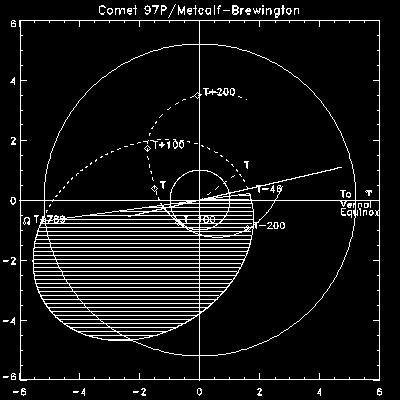
The December Journal usually includes an update on the comet prospects for the coming year. Analyses of comets appearing in any year appear on a regular basis. A report on the comets of 1991 appeared in the August 1997 BAA Journal. Unfortunately the figures for the orbits of comets 97Pand 103Pgiven in the paper are for the current orbits, not as they were in 1991. The correct figures are given in the links above.
This index to Section publications gives a brief listing of the contents of the Section Newsletters and papers published in the BAA Journal. [Updated 2002 October 14]
Comments and contact
Many thanks to those that regularly access this page for your interest. If you have any comments, suggestions for improvement or find any problems, please mail the comet section director, Jon Shanklin, but please make sure that it is possible to reply to your address. If you need to phone me I have an answer/faxphone at home on +44 (0)1223 571250 or my work number is +44 (0)1223 221400. The work fax is +44 (0)1223 221279 I can also be contacted at j.shanklin @ bas.ac.uk and snail mail will reach me at British Antarctic Survey, Madingley Road, CAMBRIDGE CB3 0ET, England. For information about my day job I have a web page at BAS.
Published by jds@ast.cam.ac.uk
Observing comets
For the beginner: Details of a comet and good and bad observations.
Some hints and tips on how to improve your observations.
Christopher Taylor contributed an article to the section newsletter which describes how to carry out simple spectroscopic studies of comets.
The Edgar Wilson Award has been instituted for amateur comet discoveries.
The 1999 Edgar Wilson Award was divided among the following six individuals or groups: Peter Williams, Heathcote, N.S.W., Australia, for C/1998 P1; Roy A. Tucker, Tucson, AZ, U.S.A., for P/1998 QP_54; Michael Jager, Weissenkirchen i.d. Wachau, Austria, for P/1998 U3; Justin Tilbrook, Clare, S.A., Australia, for C/1999 A1; Korado Korlevic and Mario Juric, Visnjan, Croatia, for P/1999 DN_3; and Steven Lee, Coonabarabran, N.S.W., Australia, for C/1999 H1. [IAUC 7223, 1999 July 14]
The 2000 Award was divided between the following three individuals or groups: Daniel W. Lynn, Kinglake West, Victoria, Australia, for C/1999 N2; Korado Korlevic, Visnjan, Croatia, for P/1999 WJ_7; and Gary Hug and Graham E. Bell, Eskridge, KS, U.S.A., for P/1999 X1. [IAUC 7445, 2000 June 29]
The 2001 Edgar Wilson Award for the discovery of comets was divided among the following two amateur astronomers for C/2000 W1: Albert Francis Arthur Lofley Jones, Stoke, Nelson, New Zealand; and Syogo Utsunomiya, Minami-Oguni machi, Aso-gun, Kumamoto-ken, Japan. [IAUC 7652, 2001 June 29]
The 2002 Edgar Wilson Award for the discovery of comets was divided among the following seven individuals: Vance Avery Petriew, Regina, SK, Canada, for P/2001 Q2; Kaoru Ikeya, Mori, Shuchi, Shizuoka, Japan, and Daqing Zhang, Kaifeng, Henan province, China, for C/2002 C1; Douglas Snyder, Palominas, AZ, U.S.A., and Shigeki Murakami, Matsunoyama, Niigata, Japan, for C/2002 E2; Syogo Utsunomiya, Minami-Oguni, Aso, Kumamoto, Japan, for C/2002 F1; William Kwong Yu Yeung, Benson, AZ, U.S.A., for P/2002 BV. [IAUC 7926, 2002 June 24]
The 2003 Edgar Wilson Award for the discovery of comets was divided among the following five individuals: Sebastian Florian Hoenig, Dossenheim, Germany, for C/2002 O4; Tetuo Kudo, Kikuchi, Kumamoto, Japan, and Shigehisa Fujikawa, Mitoyo, Kagawa, Japan, for C/2002 X5; Charles Wilson Juels, Fountain Hills, AZ, U.S.A., and Paulo Renato Centeno Holvorcem, Campinas, Brazil, for C/2002 Y1. [IAUC 8162, 2003 July 2]
The 2004 Edgar Wilson Award for the discovery of comets was divided among the following two individuals: Vello Tabur, Wanniassa, A.C.T., for C/2003 T3; and William A. Bradfield, Yankalilla, S. Australia, for C/2004 F4. [IAUC 8372, 2004 July 12]
The 2005 Edgar Wilson Award for the discovery of comets was divided among the following two individuals: Roy A. Tucker, Tucson, AZ, U.S.A., for C/2004 Q1; and Donald Edward Machholz, Jr., Colfax, CA, U.S.A., for C/2004 Q2. [IAUC 8554, 2005 June 30]
The 2006 Edgar Wilson Award for the discovery of comets was divided among the following three individuals: Charles Wilson Juels (Fountain Hills, AZ, U.S.A.) and Paulo Renato Centeno Holvorcem (Campinas, Brazil) for C/2005 N1; and John Broughton (Reedy Creek, Qld., Australia) for P/2005 T5. [IAUC 8730, 2006 July 17]
The 2007 Edgar Wilson Award for the discovery of comets was divided among the following three individuals: John Broughton (Reedy Creek, Qld., Australia) for C/2006 OF_2; David H. Levy (Tucson, AZ, U.S.A.) for P/2006 T1; and Terry Lovejoy (Thornlands, Qld., Australia) for C/2007 E2 and C/2007 K5. [IAUC 8854, 2007 July 11]
The 2008 Edgar Wilson Award for the discovery of comets was divided among the following two individuals for the discovery of C/2008 C1: Tao Chen (Suzhou City, Jiangsu province, China) and Xing Gao (Urumqi, Xinjiang province, China). [IAUC 8962, 2008 August 1]
Maik Meyer has a catalogue of comet discoveries. Don Machholz "A decade of comets" gives an account of discoveries between 1975 and 1984, and Don also has spreadsheets giving further information on amateur discoveries to date. He also provide an account of his searching in a message posted on 2008 May 6.
Current meteor showers
Meteors are the debris of comets and a meteor shower occurs if a comet's orbit intersects the earth's orbit. It is always worth watching for sporadic meteors as you never know when an outburst from some minor shower may take place. Several showers have produced enhanced returns over the last few years. [Updated 2007 September 11]
Cédric Bemer notes that the Earth passes 0.005 AU inside the orbit of comet 2006 VZ13 on 2008 May 27.1 (solar longitude 66 degrees) and that there may be a possibility of a meteor shower. The radiant is around RA 330 +16. Interestingly Peter Jenniskens lists the gamma Delphinid shower, which has a broadly similar orbit and is active from June 1 - 20 from a radiant around RA 320 +12. Jenniskens gives a possible outburst on 2013 June 11.
The 2007 Orionids gave an unexpectedly strong return, with ZHR of over 50.
More information on meteor showers can be found from
Gary Kronk
Gary Kronk's European mirror site
Phil Bagnall
International Meteor Organisation
Spaceweather
BAA Meteor Section
Other sources of information
This section gives a list of helpful urls [Updated 2002 May 14].
Meetings
This section gives details of meetings that have been held, and advance notice of forthcoming meetings.
An IWCA was held in Paris in 2004 from June 4 to 6, in association with the transit of Venus. IWCA III home page
A pro-am meeting on Comets and Meteorites was held on 2003 May 10. This included the inaugural George Alcock Memorial Lecture, which was given by Brian Marsden. The meeting was held in Milton Keynes at the Open University. Other speakers included Neil Bone, Alan Fitzsimmons, David Hughes, Monica Grady, Andrew Elliot, Iwan Williams, Nick James, Graeme Waddington and myself. Programme.Meeting report.
The "Meeting on Asteroids and Comets in Europe", MACE 2003, was held from May 1st to 4th at the Mallorca Observatory, Costitx, Mallorca, Spain.
There was an RAS discussion meeting on Cometary Science at the Launch of Rosetta on 2002 December 13 at the Geological Society Lecture Theatre, Burlington House. For more details see the RAS Meetings Calendar. An account appeared in the Aril 2003 issue of The Comet's Tale.
The Asteroids Comets Meteors (ACM2002) conference was held in Berlin from July 29 to August 2, 2002. Information on the conference is available at the meeting web site. Notes from the meeting appear in the October 2002 issue of The Comet's Tale.
There was a Section meeting associated with the BAA Ordinary meeting on Saturday 2002 February 23, notes from the meeting are included in the April 2002 issue of The Comet's Tale.
A recent professional meeting was the "5 Years After Hale Bopp" conference held in Tenerife January 21-25, 2002. Information on this conference is available at the meeting web site.
The second International Workshop on Cometary Astronomy was held in Cambridge over the weekend following the total eclipse on 1999 August 11. Details of IWCA2.
Publications The new revised and expanded comet section 'Observing Guide to Comets' is available from the BAA Office at a cost of GBP 3.50, or at selected BAA events for 3.00. Overseas and UK observers can now purchase items from the BAA Sales desk using credit cards. The Guide describes all the details you need to record to make a scientifically useful observation and also helps beginner observers to locate and view comets.
The Section Newsletter 'The Comet's Tale' is published once a year. BAA Members of the Section who contribute observations or other material receive a printed copy free of charge. Other BAA Members may subscribe to it at the rate of 5.00 pounds for three years or download it from the web. Rates for overseas members and non BAA members are negotiable. Subscriptions may be paid by credit card. The latest issue is 2007 January. Back issues for April 1999, October 1999, April 2000, October 2000, April 2001, October 2001, April 2002, October 2002, April 2003, October 2003, April 2004, October 2004, April 2005, October 2005, April 2006, January 2007, December 2007 and December 2008 are available in pdf format.
The ICQ has published a very comprehensive guide to observing comets, which covers historical observations and theory to degree level. Further details are available from the ICQ pages. This is now out of print, but may be published commercially in the near future. Some recent ICQ articles are published on line.
Pamphlet on the George Alcock memorial plaque Martin Mobberley has created a web page on George Alcock.
There is an interesting perspective on the Kuiper Belt and Comets written by Dave Jewitt.
The Section publishes an annual report each year in the BAA Journal. The following reports are available on line: 2003 / 2002 / 2001 / 2000 / 1999 / 1998 / 1997 / 1996 / 1995 / 1994 / 1993 / 1992 / 1991 / 1990. Some additional historical information about the Section can be seen from this list of Section Directors, Keedy Award winners and Newsletter Editors. This detailed history is taken from the BAA Publications 'The first fifty years' and 'The second fifty years'.
The December Journal usually includes an update on the comet prospects for the coming year. Analyses of comets appearing in any year appear on a regular basis. A report on the comets of 1991 appeared in the August 1997 BAA Journal. Unfortunately the figures for the orbits of comets 97Pand 103Pgiven in the paper are for the current orbits, not as they were in 1991. The correct figures are given in the links above.
This index to Section publications gives a brief listing of the contents of the Section Newsletters and papers published in the BAA Journal. [Updated 2002 October 14]
Comments and contact
Many thanks to those that regularly access this page for your interest. If you have any comments, suggestions for improvement or find any problems, please mail the comet section director, Jon Shanklin, but please make sure that it is possible to reply to your address. If you need to phone me I have an answer/faxphone at home on +44 (0)1223 571250 or my work number is +44 (0)1223 221400. The work fax is +44 (0)1223 221279 I can also be contacted at j.shanklin @ bas.ac.uk and snail mail will reach me at British Antarctic Survey, Madingley Road, CAMBRIDGE CB3 0ET, England. For information about my day job I have a web page at BAS.
Published by jds@ast.cam.ac.uk
Subscribe to:
Posts (Atom)